Easy Easter Bunny Coloring Book for Kids
A Designer’s First Glance: Simplicity with Soft Intent
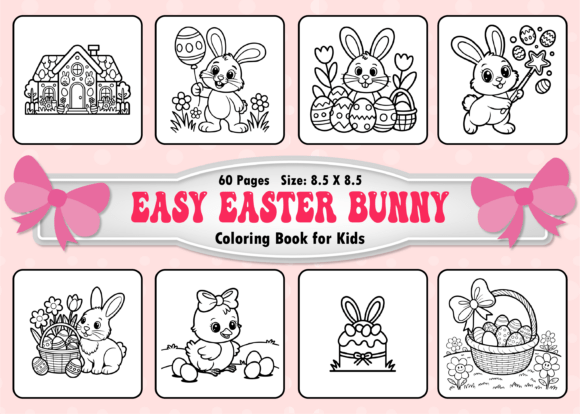
Opening Easy Easter Bunny Coloring Book for Kids, I immediately notice what it *isn’t*: no tight linework, no intricate crosshatching, no fussy outlines or nested details. What’s here instead is gentle contour, open shapes, and breathing room—exactly the kind of clean, confident line art that translates well into embroidery when handled thoughtfully. As a designer who regularly converts coloring pages into machine embroidery designs, I appreciate how this collection leans into accessibility without sacrificing charm. The bunnies feel friendly, unhurried, and age-agnostic—just right for baby onesies, toddler sweatshirts, or boutique tea towels.
From Page to Stitch: Real-World Embroidery Fit
Last week, I used one of these bunny outlines to create a custom embroidered tote bag for a local nursery boutique. We chose a mid-size hoop (5” x 7”), a lightweight cotton canvas, and a simple satin stitch border with minimal fill. The result? Crisp edges, zero thread nesting, and a hand-drawn warmth customers loved. That success wasn’t accidental—it came from the inherent design discipline in Easy Easter Bunny Coloring Book for Kids. Its bold, unbroken lines hold up beautifully under satin and running stitches. Its generous interior spaces allow for soft fill-stitch gradients or even subtle applique accents if you’re building layered patches.
This isn’t a design built for dense, high-detail commercial embroidery runs—but it *is* ideal for small-batch handmade products where clarity, charm, and quick turnaround matter. Think personalized Easter gifts: a single bunny on a linen pillow cover, a trio of bunnies stitched onto a child’s apron, or a minimalist bunny outline on a cotton cap. It also works surprisingly well as a base for digital embroidery files meant for printable mockups—clean lines scan and vectorize cleanly, making it easy to adapt for Etsy listings or craft fair displays.
Where Caution Meets Craft
That said, not every surface welcomes this design equally. On thin or stretchy fabric—like jersey baby onesies or lightweight knits—I’d add medium-weight cutaway stabilizer and reduce stitch density slightly to avoid puckering. Curved surfaces like caps or rounded pillow corners require careful placement: avoid placing a bunny’s ears too close to seam lines or curved edges, where distortion can blur the silhouette. And while the outlines are forgiving, tiny interior details—like a carrot’s leaf or a tiny egg—may vanish entirely at sub-3” hoop sizes. Test those on scrap first.
Dark fabrics demand attention too. These bunnies rely on shape and contrast—not texture or shading—so white or pastel thread pops best. If you’re stitching on navy or charcoal, skip low-contrast ecru or light gray threads. And remember: this is Coloring Pages Amp content, categorized as Graphics. That means it’s designed for coloring—not embroidery out of the box. You’ll need to digitize or adapt each image intentionally. Don’t assume auto-digitizing software will handle the flow of a bunny’s ear curve or the balance between head and body proportion. A human eye still matters most.
What This Design Adds to Your Finished Product
- Visual appeal: Instantly recognizable, seasonally warm, and emotionally inviting—ideal for holiday collections or gift-focused shops.
- Stitching clarity: Generous line weight and smooth curves mean fewer jump stitches, cleaner starts/stops, and less editing in your embroidery software.
- Product value: Customers associate simplicity with intention—not laziness—especially when paired with quality thread, thoughtful placement, and natural fabric.
- Brand consistency: Because the bunnies share a cohesive style, they support unified product lines—think matching sweatshirt + pillow + kitchen towel sets.
- Giftability: Parents, grandparents, and teachers consistently choose embroidery over print for keepsake items. A well-executed bunny from Easy Easter Bunny Coloring Book for Kids feels personal, not mass-produced.
Practical Notes Every Embroidery Designer Should Keep Handy
Before cutting fabric or loading your machine, take these steps:
- Test the design on scrap fabric *with your exact stabilizer and thread combo*—not just on paper or screen.
- Check thread color contrast against both light and dark backgrounds using a simple black-and-white mockup.
- Review stitch density: if your digitized version feels heavy, reduce fill percentages by 10–15% and retest.
- Confirm hoop size compatibility—especially if adapting multiple bunnies for a themed set (e.g., “Bunny Trio” patch).
- Inspect small details at actual stitch scale: zoom in on your embroidery software preview to spot potential weak points like narrow bridges or tight inner corners.
- Verify licensing terms before selling finished products or reselling adapted digital embroidery files—Easy Easter Bunny Coloring Book for Kids may carry usage restrictions depending on source.
Final Thought: Not Just for Coloring—But for Careful Creation
Easy Easter Bunny Coloring Book for Kids isn’t flashy. It won’t win awards for technical complexity. But as a foundation for handmade product development—whether you’re an Etsy seller launching seasonal bundles, a craft business owner designing boutique baby embroidery, or a hobbyist stitching personalized Easter gifts—it delivers something rarer: reliability with heart. Used with intention, it becomes more than a coloring page. It becomes a quiet signature—soft, sincere, and ready for thread.