Kawaii Ramen Bowl Coloring Page
First Impression: Cheerful, Compact, and Surprisingly Versatile
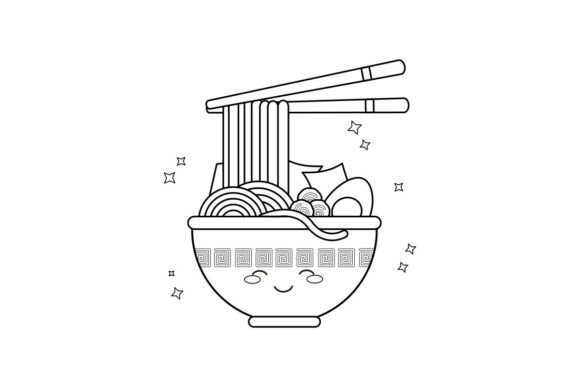
When I opened Kawaii Ramen Bowl Coloring Page, my first thought wasn’t “cute”—it was “workable.” As someone who’s stitched everything from delicate baby onesies to high-traffic tote bags, I immediately scanned for embroidery readiness: clean outlines, intentional negative space, balanced proportions, and a clear focal point. This illustration delivers that. The smiling ramen bowl sits front-and-center with chopsticks resting playfully across the rim and toppings arranged just off-center—not overcrowded, not sparse. It’s built for charm without visual noise. That matters. A coloring page designed for kids often leans into fine linework or dense cross-hatching, but this one breathes. That breathing room translates directly to stitch clarity.
A Real Project Test: Embroidering a Kitchen-Themed Tote Bag
Last week, I prepped a custom order for a local café’s staff tote bag—cotton canvas, medium weight, 8” x 10” hoop size. I chose Kawaii Ramen Bowl Coloring Page as the centerpiece because it matched their playful brand voice and resonated with their foodie clientele. Here’s what happened in practice: the bowl’s rounded shape stitched cleanly on the slightly textured fabric, the smile held its expression even at 3.5”, and the chopsticks read as distinct elements—not lost lines—thanks to generous stroke width. No redraw needed. That’s rare. Many kawaii-style graphics collapse under stitching, turning smiles into smudges and noodles into blobs. This one didn’t.
Where It Shines (and Where It Needs Thought)
Kawaii Ramen Bowl Coloring Page excels in projects where personality meets practicality:
- Embroidered patches — Its bold silhouette and minimal internal detail make it ideal for sew-on or iron-on patches on denim jackets or backpacks.
- Sweatshirt and tote bag design — The layout fills a standard 4”–5” hoop beautifully without requiring aggressive resizing.
- Baby embroidery — Soft, friendly, non-gendered, and instantly recognizable. Perfect for bibs, burp cloths, or onesie fronts.
- Holiday or boutique merchandise — Think kitchen towels for Japanese food festivals, aprons for ramen pop-ups, or pillow covers for cozy dining nooks.
- Digital embroidery file previews — Because it’s rooted in illustration, it converts cleanly to printable mockups for Etsy listings or craft fair displays.
But—and this is key—it’s not universally frictionless. On stretchy knits like t-shirt fabric, I’d digitize carefully around the bowl’s curve to avoid puckering. On dark fabric, test thread colors early: light yellow or coral for the broth, soft grey for chopsticks—avoid white unless you’re using high-contrast stabilizer. And skip ultra-fine details like individual sesame seeds if stitching for baby items; safety and wash durability come first.
Design Integrity in Finished Products
What sets Kawaii Ramen Bowl Coloring Page apart isn’t just cuteness—it’s how it supports your credibility as a maker. When customers see this on a handmade product, they don’t just register “ramen.” They sense intention: a designer who understands scale, rhythm, and context. That builds trust. A well-executed version on a linen tea towel feels boutique-worthy; on a cotton cap, it reads as clever, not cutesy. It also scales gracefully across audiences—young food lovers, anime fans, small-batch chefs, and even educators teaching Japanese culture. That flexibility makes it strong design assets for Etsy sellers juggling multiple niches or craft businesses building seasonal collections.
Practical Embroidery Designer Notes
Before cutting thread or loading your hoop:
- Test on scrap fabric first — Especially if using textured canvas or lightweight cotton. Watch how the bowl’s curves hold up.
- Check thread color contrast — Bright toppings need saturated thread; the smile line needs crisp definition. Don’t assume black-on-white is enough.
- Review stitch density — As an illustration converted for embroidery, confirm fill areas aren’t overly dense—especially in the broth section. Over-stitching causes stiffness and wear.
- Confirm hoop size compatibility — While it fits comfortably in a 5” hoop, double-check if you’re working with smaller hoops (e.g., for caps or baby hats).
- Inspect small details — The eyes and mouth are simple—but verify they won’t vanish at sub-3” sizes. If needed, simplify further in your digitizing software.
- Test in black and white mockups — Visualize it on both light and dark backgrounds. Does the expression still read?
- Use proper stabilizer — Medium-weight cutaway works best for structured items like totes; tear-away suffices for stable woven fabrics.
- Verify licensing — Since this falls under Illustrations and Graphics, confirm whether commercial use—including finished embroidered products sold online—is permitted before listing on Etsy or at craft fairs.
Final Thought: A Design That Earns Its Place
Kawaii Ramen Bowl Coloring Page doesn’t shout. It invites. It’s the kind of graphic that looks equally at home on a child’s lunchbox and a chef’s apron—not because it’s generic, but because its simplicity is deliberate. For embroidery designers and creative entrepreneurs, that’s gold. It saves time in digitizing, reduces customer revisions, and strengthens your handmade product’s emotional resonance. Whether you’re building a themed collection, fulfilling a custom apparel request, or sourcing reliable digital embroidery file options for your craft business, this one earns its spot—not as filler, but as a thoughtful, stitch-ready foundation.