Kids Party Activity SVG Design
A Lively Line Art Moment—But Does It Stitch Cleanly?
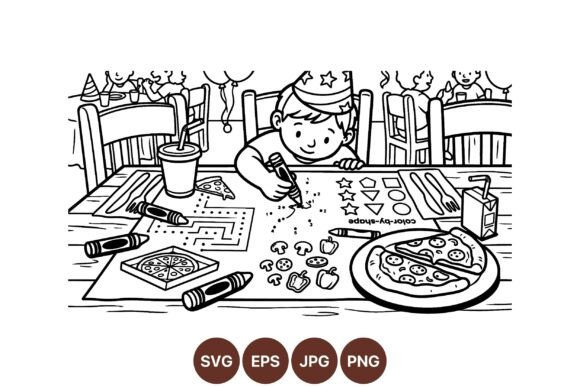
As someone who’s stitched hundreds of kids’ designs onto totes, baby onesies, and boutique aprons, my first impression of Kids Party Activity SVG Design is immediate: it’s cheerful, uncluttered, and full of narrative warmth. The line art vector shows a boy in a party hat drawing with crayons at a table piled with pizza slices and drinks—pure childhood celebration energy. It’s not overly stylized or cartoonish; instead, it lands somewhere between friendly illustration and clean graphic design. That balance makes it feel like a strong candidate for handmade products where personality matters—but only if the lines translate well into thread.
Where This Design Shines (and Where It Might Struggle)
I recently tested Kids Party Activity SVG Design as a sweatshirt embroidery project for a local preschool’s end-of-year gift—a custom crewneck for each child, with their name embroidered below the image. On midweight cotton fleece, the design held up beautifully when scaled to 4.5 inches wide. The outlines stayed crisp, the table legs read clearly, and even the tiny crayon tip held shape after stitching. That said, I wouldn’t recommend it for anything smaller than a 4-inch hoop without simplifying first—the pizza slice details and drink straws get muddy under 3 inches.
This design naturally belongs on items where storytelling adds value: embroidered tote bags for birthday party favors, pillow covers for nursery decor, tea towels for family kitchens, or patches sewn onto denim jackets. Its illustrative nature makes it ideal for boutique branding—think small shop merchandise that feels hand-curated rather than mass-produced. As a digital embroidery file, it works especially well for Etsy sellers offering personalized gifts: pair it with a monogram or date, and you’ve got a ready-made holiday embroidery or baby shower keepsake.
Fabrics & Surfaces: Know Your Limits
Kids Party Activity SVG Design performs best on stable, medium-weight fabrics: cotton twill for patches, brushed cotton for baby embroidery, and structured canvas for tote bag designs. On stretchy knits—like toddler t-shirts or lightweight sweatshirts—you’ll need cutaway stabilizer and possibly reduced stitch density to avoid puckering around the boy’s hat brim or table edge. Thin fabrics (think muslin or lightweight linen tea towels) require extra care: test stitch first, and consider using a tear-away + topping combo to keep fine lines from sinking in.
Dark fabric? Absolutely doable—but only if your machine embroidery design includes enough contrast in stitch placement. Since this is line art, avoid relying solely on fill stitches; lean into running stitch outlines and subtle satin-stitched accents (like the party hat stripe) to ensure legibility. And skip curved surfaces like caps unless you’re confident in hooping technique—the table’s horizontal lines can distort easily on a rounded crown.
What It Adds (and Doesn’t Add) to Your Finished Product
Used thoughtfully, Kids Party Activity SVG Design elevates perceived value. Customers respond to scenes—not just icons—and this one invites connection. A parent buying an embroidered pillow cover with this motif isn’t just purchasing decor; they’re choosing a memory-in-progress. That emotional resonance builds trust, especially for craft business owners selling on Etsy or at local fairs. It reads as professional, playful, and intentional—not generic clipart.
But let’s be real: it won’t work as a standalone logo or scalable brand mark. Its strength lies in context—paired with text, color blocking, or complementary elements (like a simple “Happy Birthday” banner). As a solo machine embroidery design, it’s strongest when treated as a focal point, not background filler. Also, don’t expect dense fill areas—it’s built for line clarity, not heavy coverage. If you’re aiming for bold, high-impact embroidery, you’ll want to layer it or adapt it with applique design techniques.
Practical Designer Notes Before You Stitch
- Always test first: Run Kids Party Activity SVG Design on scrap fabric matching your final product’s weight and texture—even if it’s just a corner swatch.
- Check thread color contrast: Light threads on dark fabric may disappear in thin lines (like the crayon’s paper edge); deepen stitch density slightly or add a subtle outline.
- Review stitch density: This is line art, but some vectors convert with heavier fills—open the embroidery file in your software and verify no unintended satin or fill zones exist in the pizza crust or drink condensation.
- Confirm hoop size compatibility: The original vector likely scales well, but imported embroidery files sometimes default to oversized hoops. Resize before stitching, not after.
- Inspect small details: Zoom in on the boy’s fingers, the pizza cheese strings, and drink straw angle—these are easy to lose in low-res conversions or dense stitching.
- Mock it in black and white: Print or preview Kids Party Activity SVG Design as a grayscale printable mockup. If shapes blur or merge, simplify before digitizing.
- Stabilizer matters: For textured fabrics like terry cloth tea towels, use a light cutaway + water-soluble topping to preserve line integrity.
- Licensing check: Since this falls under Illustrations and Graphics, confirm whether the download includes commercial use rights—especially if you plan to sell finished embroidered patches or digital embroidery files.
Final Thought: A Thoughtful Choice for Story-Driven Craft
Kids Party Activity SVG Design isn’t flashy—but it’s reliable, expressive, and quietly versatile. It fits seamlessly into a small shop product lineup, adds charm to personalized gifts, and gives holiday embroidery or baby embroidery projects a human touch. It won’t replace your go-to monogram or geometric border, but it absolutely earns its place alongside them—as a design that says something real, stitched with care. Just remember: line art lives or dies by execution. Respect the details, test with intention, and let the joy in the scene come through—not just in the drawing, but in the thread.