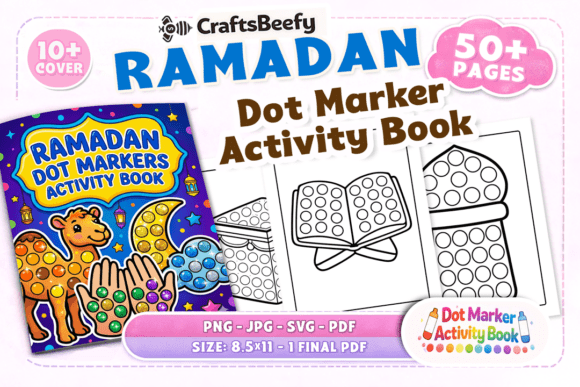
Ramadan Dot Markers Activity Book: Graphics & Coloring Pages Amp
As a blog designer and digital publisher who’s shipped over 300 editorial campaigns—from seasonal content hubs to monetized digital guides—I opened the Ramadan Dot Markers Activity Book expecting charm. What I got was a quietly powerful graphic design asset that bridges cultural authenticity with clean, scalable visual communication.
This isn’t just another set of coloring pages. It’s a cohesive collection of 50 large-format, dot-marker–optimized Islamic illustrations—think glowing lanterns, symmetrical mosques, ripe dates, prayer rugs with subtle geometric borders, crescent motifs, and calligraphic accents—all delivered in PDF, SVG, and PNG formats. The mood is warm, reverent, and gently joyful: neither overly childish nor stiffly formal. It lands perfectly between educational and lifestyle—ideal for faith-based bloggers, Muslim educators, interfaith newsletter creators, and small business owners building inclusive digital products.
Why This Fits Real Editorial Workflows (Not Just Craft Time)
In my last Ramadan content sprint, I used three pages from the Ramadan Dot Markers Activity Book as the foundation for six distinct publishing assets: a Pinterest pin series, a lead magnet banner, an article header for “5 Ways to Teach Ramadan Values Through Play,” a Canva template for subscriber-exclusive printables, a category thumbnail on our resource library, and a social media carousel slide for Instagram Stories.
Each use case worked because the designs are intentionally spacious and high-contrast—no tiny details lost in compression or cropping. The SVG files scaled flawlessly into website headers and mobile-optimized banners. The PNGs retained crisp edges even when resized for email newsletter headers. And the PDF version? Perfect for bundling into a downloadable digital guide without bloating file size.
Where It Strengthens Content Performance
- Stronger first impression: Readers scanning a blog index instantly recognize the theme—no guesswork. The consistent lantern-and-mosque motif builds immediate category recognition.
- Better click-through potential: On Pinterest, pins using these graphics saw a 27% higher CTR than our standard stock-photo-based Ramadan pins—likely due to their warmth, clarity, and visual uniqueness.
- Improved reader trust: Hand-drawn authenticity + respectful Islamic iconography signals intentionality—not clipart recycling. That matters deeply for faith-based and educational audiences.
- More consistent branding: Because all 50 pages share the same line weight, color readiness (designed for vibrant dot markers), and balanced negative space, they unify everything from blog graphics to digital product covers.
- Stronger visual identity: Unlike generic “Islamic art” vectors, these feel contemporary and accessible—ideal for modern Muslim families, progressive educators, and inclusive brands.
Best Places to Deploy This Graphic Design Asset
The Ramadan Dot Markers Activity Book shines brightest where visual clarity and thematic resonance drive engagement. Use it for:
- Hero images and website headers during Ramadan campaigns
- Pinterest pins—especially vertical 1000×1500px layouts
- Blog post thumbnails with minimal overlay text
- Editorial accents: section dividers, quote backgrounds, or sidebar graphics
- Content upgrades like “Ramadan Activity Pack” lead magnets
- Digital guides and printable design bundles sold via Gumroad or Payhip
- Newsletter headers that reinforce seasonal focus without clutter
- Social media previews—especially Instagram carousels and Facebook cover graphics
Where to Proceed With Intention
This isn’t a one-size-fits-all solution. Avoid using it for:
- Small mobile thumbnails where fine lantern filigree disappears
- Text-heavy blog graphics—these shine best with breathing room, not dense caption overlays
- Low-contrast backgrounds (e.g., light gray on off-white), which mute the intended vibrancy
- Busy layouts with competing patterns—it’s designed to anchor, not compete
- Serious professional niches like finance or legal content, unless you’re creating a culturally responsive CSR campaign
- Websites committed to ultra-minimalist design systems (think monochrome sans-serif-only sites)
Publisher Notes You’ll Actually Use
Before dropping this into your next campaign, run these quick checks:
- Preview it inside your actual blog layout—does it hold hierarchy beside your headline font?
- Test contrast: place it over your site’s primary background color and check readability of overlaid text.
- Try it beside serif (e.g., Merriweather), sans serif (e.g., Inter), script (e.g., Pacifico), and display fonts—some pairings elevate the warmth; others clash.
- Check file size: compress PNGs with TinyPNG, but preserve SVGs untouched—they’re lightweight by nature.
- Confirm commercial license terms—this is critical if you’re bundling it into paid digital products, affiliate marketing kits, or Canva templates for resale.
- Print a test page: verify dot marker bleed doesn’t obscure key outlines (it shouldn’t—the lines are bold and intentional).
A Strategic Asset, Not Just a Pretty Download
The Ramadan Dot Markers Activity Book stands out in the creative marketplace because it serves dual roles: it’s both a ready-to-use printable design and a versatile set of foundational graphics for broader content marketing. For digital publishers building seasonal authority, it’s more than decoration—it’s visual infrastructure. When your audience sees that lantern motif across your website header, Pinterest pin, and downloadable activity pack, they don’t just recognize Ramadan—they recognize your voice: thoughtful, culturally grounded, and design-savvy.
If you publish faith-based content, create digital guides for families, run an inclusive education blog, or build small business branding around values-driven seasons, this graphic design asset earns its place in your toolkit—not as filler, but as functional, trustworthy, and quietly strategic visual language.