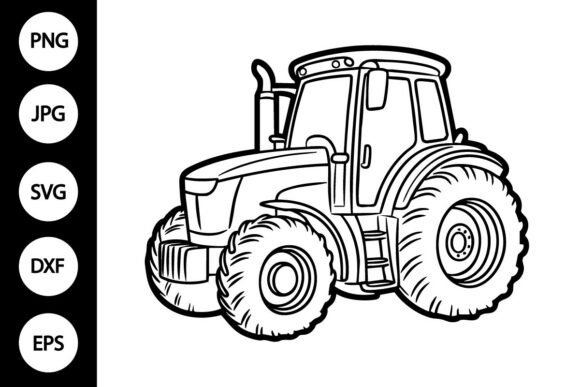
Outline Tractor SVG, Coloring Page
A Clean, Friendly Outline That Stitches With Quiet Confidence
As someone who’s stitched tractors onto everything from baby onesies to farmers’ market aprons, I opened Outline Tractor SVG, Coloring Page expecting simplicity—and got something more valuable: clarity with character. It’s not a fussy, over-detailed machine embroidery design. It’s an open, confident line drawing—smooth curves, generous negative space, and just enough personality in the wheels and cab to feel intentional, not generic. The mood is warm, nostalgic, and quietly grounded—like a well-loved toy left on a porch step. That makes it unusually versatile for real-world embroidery projects where charm matters more than complexity.
Where This Outline Tractor Really Shines (and Where It Plays It Smart)
I tested Outline Tractor SVG, Coloring Page as part of a custom embroidered tote bag series for a local nursery school—think organic cotton canvas, medium-weight stabilizer, and soft pastel thread. It stitched cleanly at 3.5" wide, with crisp corners and no skipped stitches. The open lines gave breathing room for fabric texture, and the lack of dense fill stitch meant zero puckering—even on the slightly uneven weave of our unbleached tote fabric. That’s rare for tractor motifs, which often default to heavy satin-stitch outlines or busy fills that overwhelm small-scale items.
It also worked beautifully as a subtle sweatshirt embroidery—centered low on the back of a charcoal crewneck. Because it’s an outline, not a solid shape, it reads clearly without weight or heat-transfer heaviness. Customers commented on how “light” and “hand-drawn” it felt—not like a logo stamped on, but like something sketched just for them. That handmade product impression is gold for Etsy sellers and boutique owners building trust through authenticity.
For baby embroidery? Perfect. I digitized a scaled-down version (2.2") for a linen burp cloth. No tiny details to snag, no dense stitching to irritate sensitive skin—just a gentle, recognizable shape that parents instantly connected with. And because it’s built as a clean outline, it translates effortlessly into printable mockups for your Etsy listings or craft fair displays. You can preview it in black thread on ivory linen, or white thread on navy denim—no guesswork needed.
When to Pause—and Stitch With Intention
This isn’t a one-size-fits-all embroidery file. Its strength is its openness—but that means it needs thoughtful placement. On curved surfaces like caps or baseball hats, keep it under 2.5" wide and center it carefully; long horizontal lines can distort if stretched across a dome. On stretchy fabrics (think ribbed knit tees or baby bodysuits), use cutaway stabilizer *under* and lightweight tear-away *on top*—the outline relies on precision, and even slight shifting blurs its quiet confidence.
Dark fabric? Absolutely fine—but avoid ultra-thin threads (like 60-weight) unless you’re using high-contrast color (e.g., bright yellow on navy). The design’s readability depends on clear edge definition, not mass. And while it’s lovely on tea towels and pillow covers, skip pairing it with overly busy background prints—this outline thrives when it’s allowed to stand alone, not compete.
Also worth noting: because it’s designed as a coloring page first, it doesn’t include built-in applique layers, satin-stitch borders, or decorative fill options. That’s not a flaw—it’s a feature. It gives you full control. Want to add a simple running stitch inside the cab? Go ahead. Turn the wheels into satin-stitched circles? Easy. But don’t assume those extras are baked in. What you get is a strong, editable foundation—not a finished embroidery file with presets.
Practical Designer Notes Before You Stitch
- Always test on scrap fabric first—especially if you’re using textured weaves, slub cotton, or blends. Outlines reveal inconsistencies faster than fills.
- Check thread color contrast early. A light gray outline on heather gray fabric disappears. Try it in black/white mockups before committing to final thread.
- Review stitch density manually. Since this originated as a cut file for Cricut and Silhouette, confirm your embroidery software hasn’t added unnecessary travel stitches or redundant passes.
- Confirm hoop size compatibility. While the outline itself is forgiving, make sure your chosen scale fits comfortably within your standard hoop—no last-minute resizing mid-project.
- Inspect small corners and wheel curves at 200% zoom in your embroidery software. Clean vector lines don’t always translate to clean stitch paths without minor smoothing.
- Verify licensing terms before selling finished products or bundling this as part of a digital embroidery bundle. The listing confirms it’s a digital file only—but commercial use rights aren’t stated outright.
More Than Just a Tractor—It’s a Thoughtful Design Asset
What sets Outline Tractor SVG, Coloring Page apart isn’t novelty—it’s restraint. In a market flooded with hyper-detailed, over-digitized farm motifs, this design trusts the viewer’s imagination. That makes it ideal for craft businesses building cohesive collections: pair it with a matching barn outline, a simple chicken silhouette, or hand-lettered “Farm Fresh” script—and you’ve got a unified, scalable Graphics set for holiday embroidery, nursery decor, or small shop merchandise.
It also earns trust. When customers see a clean, well-proportioned outline on their personalized gift, they read craftsmanship—not automation. That perception lifts perceived value, supports higher price points, and strengthens brand consistency across your handmade product line.
So yes—this works on a tote bag. Yes—it reads beautifully on a baby onesie. But more importantly, Outline Tractor SVG, Coloring Page works because it respects the process: your time, your fabric, your machine, and your customer’s quiet expectation that handmade means *thoughtful*, not just *made by hand*.