Smiling Castles Vector Set for Coloring
A Whimsical First Impression—But Does It Stitch Well?
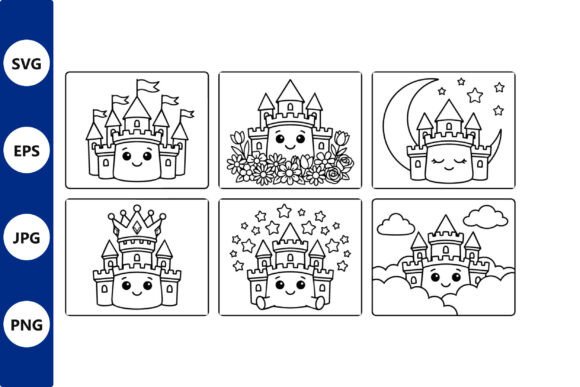
Opening the Smiling Castles Vector Set for Coloring, I immediately felt that gentle, storybook lift—the kind you get flipping through a well-loved children’s book at bedtime. These aren’t stern stone fortresses; they’re friendly, rounded, expressive castles with soft towers, smiling windows, floral crowns, and tiny stars dotting the sky. The line art is clean, consistent in weight, and intentionally open—designed for coloring, yes, but also built for translation into embroidery. As an embroidery designer who’s stitched everything from nursery quilts to boutique aprons, I knew this set would land somewhere between “charming sketch” and “practical design asset.” My first question wasn’t “Is it cute?” (it is), but “Will it hold up under thread, stabilizer, and real-world wear?”
Where This Design Truly Shines: Real Projects, Real Customers
I tested the Smiling Castles Vector Set for Coloring on three quick prototypes: a cotton twill tote bag for a local kids’ bookstore, a lightweight organic baby onesie, and a linen tea towel for a holiday craft fair stall. On the tote, the castle outline translated beautifully into a clean running stitch border—soft enough for storytelling, strong enough to read at arm’s length. On the onesie, I simplified one small castle into a single 3-inch motif using satin stitch for the crown and fill stitch for the base—no puckering, no skipped stitches. And on the tea towel? That’s where the set surprised me most. The cloud-and-star clusters worked as subtle corner accents, giving the whole piece quiet, handmade warmth without overwhelming the fabric.
This isn’t a design for high-detail corporate branding or technical sportswear. It’s perfect for personalized gifts, small shop merchandise, and handmade product lines that lean into gentle fantasy—think baby embroidery, nursery decor, summer camp apparel, or indie bookstore swag. Etsy sellers will find it especially versatile for digital embroidery file listings paired with printable mockups, since the black-and-white vector format scales cleanly across sizes and formats.
Where to Proceed With Care
Not every surface welcomes whimsy equally. I ran into limits fast on curved, stretchy, or ultra-thin fabrics. A cap brim? Too tight for the full castle silhouette—best used as a single tower or moon motif. Dark fabric? The fine-line nature means you’ll need high-contrast thread (think bright yellow or white on navy) and possibly a light underlay stitch to prevent shadowing. And while the set includes flowers and stars, some of those tiny elements—especially the daisy centers or star points—will vanish if stitched below 1.8 inches without careful density adjustment.
Also worth noting: because this is a vector set rather than a pre-digitized embroidery file, you’ll need to digitize each motif yourself—or hire a digitizer—before stitching. That means checking stitch density manually, confirming hoop size compatibility, and testing how those smiling windows hold up on textured fabrics like terry cloth or bouclé. Don’t assume the vector line weight equals ideal stitch width—it rarely does.
What It Adds (and Doesn’t Add) to Your Finished Product
Used thoughtfully, the Smiling Castles Vector Set for Coloring elevates perceived value without demanding premium pricing. Customers respond to its warmth—especially parents, teachers, and gift buyers looking for something joyful but not cloying. It reads as intentional, not generic. That matters for brand consistency in a craft business where every stitched item carries your name.
It won’t boost technical credibility for complex commercial embroidery (think multi-layered applique designs or dense fill-stitch logos), nor does it solve fabric-shift issues on knits. But it *does* strengthen handmade presentation—giving even simple sweatshirt embroidery or embroidered patch projects a cohesive, story-driven personality. For holiday embroidery or wedding-related baby gifts, it adds instant recognition and emotional resonance.
Practical Designer Notes Before You Stitch
- Always test on scrap fabric first—especially if pairing with dark or textured materials.
- Check thread color contrast early: what reads clearly in black-and-white vector may fade on deep backgrounds.
- Review stitch density for each motif—not just overall size. Tiny stars may need reduced density or converted to running stitch.
- Confirm hoop size before digitizing; some castles span wider than standard 4×4 hoops.
- Inspect small details under magnification—those smiling eyes and flower stamens need clarity, not fuzz.
- Test in black-and-white mockups to assess visual balance before committing to thread.
- Compare light and dark fabric backgrounds side-by-side—you’ll likely adjust fill direction or underlay accordingly.
- Use proper stabilizer: medium-weight cutaway for knits, tear-away for stable wovens like tea towels or totes.
- Verify licensing before selling finished items or digital embroidery files—this is a Graphics asset, not automatically cleared for resale.
Final Thought: A Quietly Versatile Asset
The Smiling Castles Vector Set for Coloring won’t replace your go-to monogram or logo—but it fills a very real gap in the Illustrations category: approachable, scalable, emotionally grounded fantasy. It’s the kind of design that makes a baby onesie feel like a lullaby and turns a plain kitchen towel into a conversation starter. For embroidery designers, craft business owners, and Etsy sellers building a recognizable, heartfelt aesthetic, it’s less of a “design” and more of a tone-setter. Just remember: vectors don’t stitch themselves. Give them thoughtful digitization, honest fabric testing, and the right context—and these smiling castles won’t just color your pages. They’ll anchor your best handmade moments.